
Staying connected
Technical issues with online learning
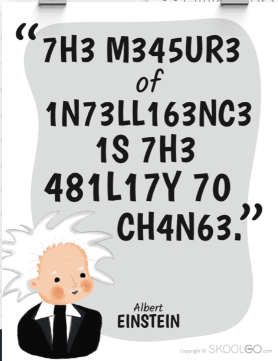
We're really not sure whether Einstein said the quote below or if was someone else, but it's a good quote! We could definitely apply it to the search for flexibility and new ideas whenever larger circumstances push us into finding unorthodox solutions. This is especially true whenever we are trying to stay connected in online learning situations.
The world has been living in strange times. We have suffered in recent times from globalised health scares and as a result there could be problems with travel at any minute, causing many workers and learners to go online for their jobs and courses. Video conference platforms have become more popular than ever before and their value in the stock market has risen meteorically. Many teaching companies have had to go online whenever their locations go into lockdown and even when students are allowed to attend face-to-face classes, many of these companies have chosen to maintain online offers in case of another quarantine. However, many teachers and students have also found that they like online learning as it solves many problems in attending face-to-face classes, like travel and timetabling.
What does an effective online class look like then, and how does an experienced teacher or teaching organisation manage problems with computers or the internet. There are a few issues which students and teachers face and have to think about online learning, but we might find solutions by looking at more traditional learning situations.
Unstable internet connections or internet cuts during class.
The internet is under pressure due to its increased use and the dependency that many people now have on it for their learning and livelihoods. As a result, it is not uncommon to experience an unstable connection, even if you have a good personal online connection at home, as there may be a more general problem in your area or even globally. Students might also be working with limited technological resources, the typical issue being that a student is working on a mobile phone during a live class. Working on mobiles can cause issues, but they need not cause too much disruption as long as there are certain backups to support delivery of tasks.
Problems with computers themselves.
We can all have basic problems with computers at the worst of times so we need to have a backup plan to make sure that we can participate in a class. The most basic tools you require to be able to participate in a learning class is to have a pen and paper, or somewhere to type and save. Sometimes, the type and save option is not available so having the absolute basics of a pen and notebook at hand become necessary. The telephone is also a basic tool which we can use and if you have a chat application like WhatsApp, you can have video classes. However, if you have problems with the internet, the phone line can act as a backup. Although it is preferable to have visual contact, you don’t always need to see each other to be able to interact.
So, what can we do?
We might find a solution to faulty connections if we think a little outside the box and consider what students and teachers do in their ordinary, or more traditional, learning situations. Do a teacher and student always have to see each other or can’t the learning process continue without visual contact? Don't teachers need to leave students alone to do a lot of tasks, with the teacher simply available or on call to answer occasional questions? Shouldn’t a teacher send the tasks to the student beforehand and after class so that the student can look over the material, then think of questions during face-to-face or live time with the teacher?
Importantly, what is the difference between solving these problems in a one-to-one situation or in a group class?
Group classes might be more difficult to follow for one or two students who are experiencing problems while the others work with functioning technology, so making sure that they have tasks to follow which relate to the learning point is essential.
One-to-one classes have issues with staying connected which are probably easier to solve as they only involve two people, and a connection between the teacher and an individual student can be established more easily than situations with more than one student having problems.
Solving issues by looking at traditional methods.
If we think about these questions, and we consider how students and teachers normally interact, we can begin to structure an online class and course which does not rely so heavily on the speed of the internet connection, so staying connected constantly isn't so essential.
Technical issues are things that we need to make sure to avoid, and good preparation can avoid the majority of breakdowns. Nevertheless, there are always going to be circumstances beyond all of our controls. Power cuts made by city or national authorities making repairs to electrical or electronic systems are unavoidable, and they can happen during class time, leaving us without internet. These are probably not very common but if it happens, we have to manage such situations for the benefit of the student and the flow of the course.
Importantly, we have to think about how or when we deliver tasks, and why we are actually having live classes or what we are using the live part of the course for, which should be for communicative tasks or practice. What we must do in emergency situations is try to keep the student on track with tasks to complete and a teacher-student connection for extra questions and guidance which temporarily doesn’t require the internet, like the telephone. If we deliver tasks previously or leave them on an online drive to collect previously, especially a drive which permits working offline, then the student can continue the course with as little disruption as possible and still be in contact with the teacher.
Many forms of contact, and not just staying connected for the sake of it.
Staying connected and in contact with a form of communication less reliant on the electricity supply or the internet connection, or both of these at the same time, provides an extra line of contact to keep the conversation going, or when the student needs help. All in all, the idea is to create a quiet place for the student to work and a place to talk with the teacher whenever needed, where they can do the tasks without always being in front of the teacher. If we can do this despite the internet’s technical issues, we can promote successful learning.
