Beyond the Coursebook: Authentic Materials Without the Planning Marathon
Coursebooks provide useful structure, but learners also benefit from encountering English that was created for a genuine purpose: a video, podcast, review, article, timetable or social-media post. Here we look at teaching with authentic materials and AI editing to make the process of lesson planning quicker
The problem is rarely finding authentic material. The problem is turning it into a focused, accessible lesson without losing an evening to preparation.
AI can help—as a planning colleague, not an autopilot.
Use the REAL Loop
The REAL Loop is a practical four-stage process:
- R — Relevance: Why this source, for these learners, now?
- E — Evaluate: What is useful, difficult, transferable or potentially unsuitable?
- A — Adapt: How can the task and support make the source accessible?
- L — Look again: Are the transcript, questions and answers accurate and appropriate?
The central principle is simple:
Keep the source where possible. Grade the task and the support.
Learners do not necessarily need a rewritten, simplified version of everything. They may need a shorter extract, visual support, repeated listening, a selective glossary or a more manageable task.
A quick AI-assisted workflow
Choose a short section with:
- an obvious audience and purpose;
- approximately 120–200 transcript words;
- a recognisable or relevant topic;
- two or three useful language items;
- a genuine decision or response for learners to make.
Give the source or transcript to your preferred AI tool and ask it to analyse the material before creating activities.
Try this prompt:
Analyse this source for my learners. Identify its audience and purpose, likely comprehension barriers, two or three transferable language items, and one genuine response learners could make. Do not invent information. Flag anything uncertain.
Then build a simple sequence:
- Gist: One question about the main situation or purpose.
- Notice: Two or three useful expressions or discourse features.
- Respond: A recommendation, decision, comparison, explanation or short creation.
What might this look like?
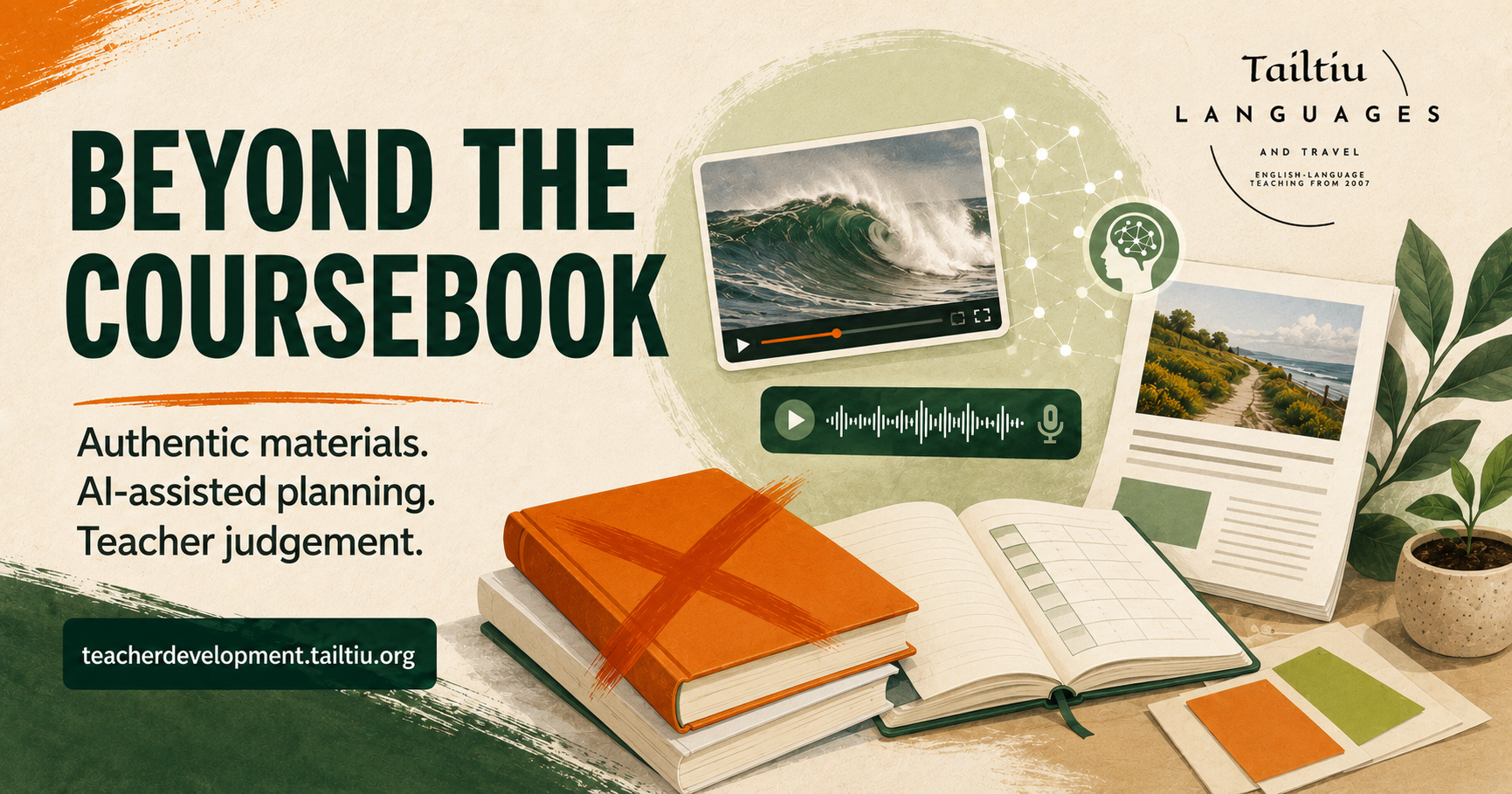
In the accompanying worked example, a 94-second extract from a documentary about Irish big-wave surfing becomes a compact B1+/B2 activity.
Learners:
- identify why surfers are gathering before dawn;
- notice expressions such as can be a lottery, with a day’s notice and be in for a treat;
- record a 30-second voice message recommending whether a classmate should watch the rest of the documentary.
The authentic source remains intact, but the learning journey is carefully supported.
The teacher still decides
AI can transcribe, analyse, suggest, draft and double-check. It cannot reliably know your learners, institutional requirements or whether every inference is supported by the source.
Before teaching, check:
- Is every answer demonstrably supported?
- Is the language genuinely useful?
- Is the content appropriate and accessible?
- Does the final task give learners a real reason to communicate?
- Is the activity worth the classroom time?
AI drafts. The teacher decides.
Download the free editable toolkit and seminar slides below on teaching with authentic materials and AI editing, including the participant handout, REAL Loop planning template, AI prompt bank and complete surfing worked example—from Tailtiu Teacher Development.
